Deal has had a remarkable past for a town without a harbour. It grew from a small fishing community on a steep shingle beach into one of the busiest anchorages in the world because of the sheltered water of the Downs, between the shore and the Goodwin Sands. Armies, navies, smugglers and lifeboatmen all left their mark. Here are the highlights, starting with the legend that Julius Caesar's legions landed on this very beach.
55 BC
Julius Caesar and the Roman landing

Deal's story begins, according to tradition, with Julius Caesar. In late summer 55 BC he crossed from Gaul with two legions, hoping for an easy landing. Off Dover he found Britons massed along the white cliffs, close enough to hurl javelins down on any ship that came in. So he turned the fleet and sailed about seven miles up the coast to a flat, open beach, which is the stretch of shingle between Deal and Walmer.
The Britons followed along the cliffs and a fierce fight broke out in the surf. A few days later a storm damaged many of the Roman ships drawn up on the beach, and Caesar sailed back to Gaul without going far inland. He returned the following summer, in 54 BC, with a far larger fleet, and again tradition puts the landing at Deal and Walmer. A memorial on the seafront still marks it.
There is a catch. The traditional site has never been backed up by archaeology, and in recent years a team from the University of Leicester has argued that the evidence points a few miles north, to Pegwell Bay in Thanet, where they found the remains of a Roman fort. The argument is still going on, which is why Deal can say only that Caesar is thought to have landed here. Few towns in Britain have a better excuse for a good story.
1086
A village called Addelam
After the Romans, the record goes quiet for centuries. Deal turns up in the Domesday Book of 1086 as Addelam, a small farming and fishing settlement set back from the shore. Over the next few hundred years its name appears as Dela and then Dale, and the town slowly shifted nearer to the sea and the living it offered.
1200s
A limb of the Cinque Ports
By the middle of the thirteenth century Deal was counted among the Cinque Ports, the medieval confederation of south-east coastal towns that supplied ships and men to the Crown in return for special privileges. Deal was a "limb" of Sandwich, which governed it, and became a port in its own right by the end of the century.
It was an unusual port, because it never had a harbour. Boats were launched straight off the steep shingle beach, a way of working that would define the town for the next 600 years. When Sandwich's harbour silted up, Deal's beach boats became the only way to supply the ships anchored offshore.
1495
The Battle of Deal
In 1495 the pretender Perkin Warbeck, who claimed to be the lost son of Edward IV, tried to land near Deal with a small force, hoping to seize the crown from Henry VII. Local men loyal to the king drove his landing party back into the sea, and Warbeck sailed away. The skirmish on the beach is remembered as the Battle of Deal.
1539
Henry VIII builds three castles
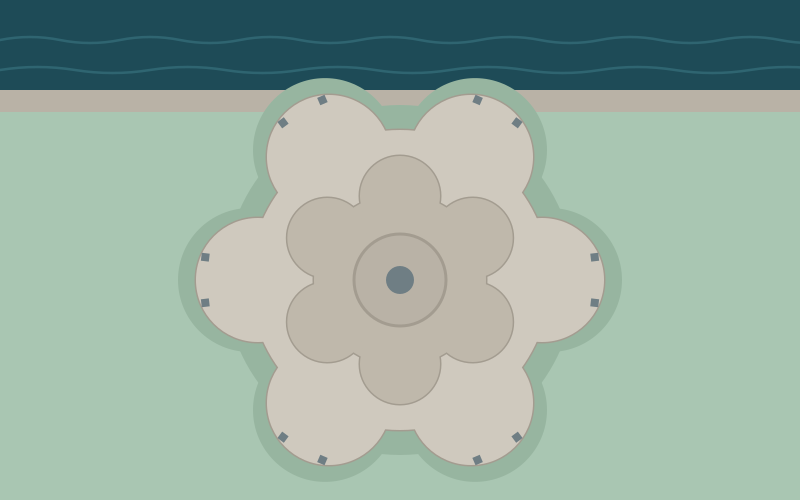
In 1539 England feared invasion by France and Spain, and Henry VIII ordered a chain of artillery forts along the south coast. At Deal he built three, Sandown, Deal and Walmer, to guard the sheltered anchorage known as the Downs. Deal Castle, shaped like a Tudor rose, was the largest. Most of it was finished by the end of the year, when Anne of Cleves landed here on 27 December on her way to meet Henry, and rested in the unfinished castle.
The invasion never came. Walmer Castle later became the residence of the Lord Warden of the Cinque Ports and Sandown Castle was lost to the sea, but Deal survives much as it was built. Read more in our guide to the two Tudor castles.
1648
Civil war comes to the beach
In 1648, during the Second Civil War, ships of the fleet in the Downs mutinied and the garrisons of the three castles declared for the king. Parliament sent Colonel Nathaniel Rich to retake them. Walmer fell in July after a heavy bombardment. Deal held out until a relief force was beaten back in the fighting of mid-August, and surrendered in late August, with Sandown following in early September.
1672
The Naval Yard
In 1672 a small Naval Yard was set up beside the beach to supply the Royal Navy ships that waited in the Downs. It was never a dockyard, since Deal had no dock, but it stored provisions and equipment and carried out minor repairs, with the stores taken out to the ships in small boats. It stayed open until 1864, and the Timeball Tower still stands at what was its entrance.
1699
A royal charter
As ships crowded into the Downs through the wars of the late seventeenth century, Deal grew rich, and its people grew tired of being run from Sandwich. In 1699, after a long and bitter dispute, William III granted the town a royal charter that made it a free borough with its own mayor and its own market. The Saturday market that still fills the north end of the High Street is a descendant of that charter.
1703
The Great Storm
The anchorage that made Deal's fortune could also be deadly. In the Great Storm of 26 and 27 November 1703, ships dragged their anchors and were driven onto the Goodwin Sands six miles offshore. Four Royal Navy warships were lost with around 1,200 men. Deal's boatmen launched their boats from the exposed beach and crossed miles of wild water to bring survivors of HMS Stirling Castle ashore after two nights on the wreck.
1700s
Hovellers, luggers and smugglers
Deal's boatmen, known as hovellers, were famous for their seamanship. In big, open luggers they salvaged cargoes, rescued the shipwrecked and supplied the fleets, and some of them also smuggled. Tea, brandy and tobacco passed through the town's narrow lanes in such quantity that Prime Minister William Pitt the Younger is said to have sent troops to burn the luggers on the beach in the 1780s. The twisting alleys around Middle Street, with their many doors and cellars, are a reminder of those years.
Admiral Nelson knew the town well, visiting while his ships lay in the Downs, and the Napoleonic Wars turned Deal into a garrison town. A naval hospital and barracks were built in the 1790s, and from 1815 "blockade men" were quartered here to suppress smuggling. The signal tower at the Naval Yard, part of a chain of stations linking it to the Admiralty in London, became the Timeball Tower, which dropped its ball at one o'clock each day from 1855 so that ships could set their chronometers. Radio time signals made the ball obsolete in 1927, but it has since been restored, and it still drops at one o'clock every day.
1800s
Railways, bathing and the Royal Marines
The railway reached Deal in the middle of the nineteenth century, bringing visitors who came for sea bathing and fresh air. The Royal Marines arrived in 1861 and made the old barracks their depot, beginning a connection with the town that lasted for well over a century. The Naval Yard closed in 1864. Deal's first pier, built in 1838, was destroyed by a storm in 1857, and a Victorian successor took its place.
1939 to 1945
On the front line
In the Second World War Deal was only about 25 miles from occupied France. The Royal Marines Depot was bombed in October 1940, and German bombs destroyed the captain's quarters at Deal Castle, which spent the rest of the war as an observation post for a coastal gun battery. The Victorian pier was hit by a ship in 1940 and largely cleared away afterwards.
1957
A new pier
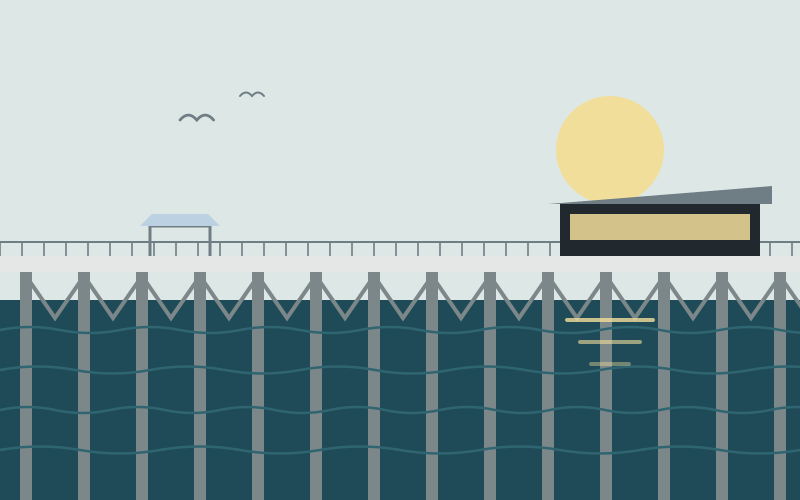
The pier you can walk along today is the third on the site. Designed by Sir William Halcrow and Partners, it was opened by the Duke of Edinburgh in November 1957 and is the last fully intact leisure pier in Kent. The town was also protecting its older streets: in 1968 Middle Street became the first conservation area in Kent.
1989
A day of loss
On the morning of 22 September 1989 the IRA exploded a bomb at the Royal Marines School of Music at the Deal barracks. Eleven bandsmen were killed and many more were injured. The Deal Memorial Bandstand on Walmer Green is their memorial, and the Royal Marines Band still returns each year to remember them. The School of Music left for Portsmouth in 1996 and the barracks were turned into homes. Betteshanger colliery, just north of town, also closed in 1989.
Today
Deal now
Today the town that launched lifeboats from the shingle and watched whole fleets ride at anchor is a place of independent shops, a Saturday market, a pier and a long beach. The castles are open to visit, the boats still sit on the shingle, and the stories of Deal's past are never far away. For more, see our guide to things to do, or read about a stroll down Middle Street.
Sources and further reading
- David Skardon's Deal Kent History — A personal archive of old photographs and stories of Deal beach and its boatmen and boatbuilding families.
- Deal Maritime and Local History Museum — The town's own museum, with displays on smuggling, boatbuilding and local life.
- Deal Timeball Tower Museum — Opening times, and when the ball rises and drops.
- English Heritage: history of Deal Castle — The Tudor fort, the 1648 siege and the Captains of Deal.
- Deal Town Council: the history of Deal Town Hall — How Deal became a free borough in 1699.
- British History Online: the town and parish of Deal — Edward Hasted's eighteenth-century survey of the town.
- Goodwin Sands Conservation Trust: Deal and the Great Storm of 1703 — The storm and the rescue attempts from Deal beach.
- The Conversation: where Julius Caesar landed — The Leicester archaeologists' case for Pegwell Bay.